

We use cookies to improve your experience on our site.
By using our website, you agree to our use of cookies. Find out more information on how we use cookies, view our privacy policy.



How many managers frustratingly ask themselves:
“Why can’t I get my people to do what I want them to do?”
They devise elaborate incentive plans. They threaten unemployment, tongue lashings and belittlement. Still they wonder: “Where’s the motivation?”

When was the last time you got a raise? How long did it take before you got used to that income level? Why should anyone else be different?
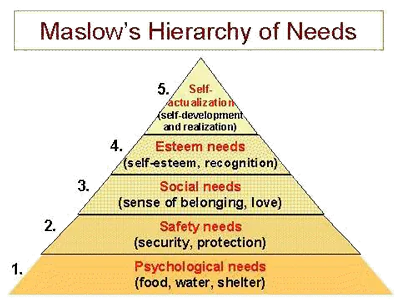
Most of us studied Abraham Maslow’s Hierarchy of Needs (right) in college. It was either in management class or psychology class or both. As applied to Business Management, humans have higher level needs that go beyond simply getting paid. We achieve higher levels of performance when we are fulfilling higher level needs. As we understand the higher levels, we are more likely to tap into our people’s intrinsic motives.
We gained this book knowledge. Then we got into the workplace neglected to apply this knowledge in favor of more capitalistic principles and to serve impatient bosses and unrealistic goals. American managers assume that money and fear are the quickest path to meeting the goals for the next month or quarter. Managers invest far more time devising extrinsic financial incentives than they do addressing intrinsic. Who has time for that touchy-feely stuff anyway? With the use of that adjective, managers discard scientific fact in favor of machismo.
– Daniel Pink, author of Drive
Perhaps Maslow’s 1943 theories seem old and tired to you. But how well does a steady diet of carrots and sticks really work?
When will so-called managers get over their phobia for the touchy-feely and realize that their people are emotional beings and not machines with push buttons?
If it takes a current champion, allow me to suggest the previously quoted Daniel Pink. Daniel Pink wrote the 2009 book Drive: The Surprising Truth About What Motivates Us. The book documents the failures of financial performance systems and provides examples of organizations who have developed new “operating systems” that foster intrinsic motivation.
He shares three key elements necessary for developing intrinsic motivation:


The urge to direct our own lives.
The desire to get better and better at something that matters.
The yearning to do what we do in the service of something larger than ourselves.
Abraham Maslow doesn’t have a video. Daniel Pink does. If you want the Cliff Notes for Drive, here is Daniel Pink on Ted Talks (18 minutes).
As Daniel Pink suggests, getting people intrinsically motivated requires implementing a new operating system. That is only possible if we can reconcile the conflict between Compliance vs. Engagement. Managers inherently want to remove variables for the sake of consistency. Leading an environment of engagement requires embracing innovate approaches to solving problems.
Becoming a leader who engages means letting go of the part of you that wants to control and embracing the part of you that wants to empower.
Control-happy managers need to adapt or find place that still believe in finding sweeter carrots and sharper sticks. Your job get easier if remember that you are leading emotionally driven human beings, not push button devices. And relying on pushing those buttons doesn’t work.
By using our website, you agree to our use of cookies. Find out more information on how we use cookies, view our privacy policy.