


This is becoming a more common suggestion – especially to high potential leaders. Have you heard it yet? Have you said it yet? In some circles, Executive Presence has become a buzz phrase. All too often buzz words and phrases are tossed out in a feeble attempt to sound relevant. But when your audience doesn’t understand your meaning any more than you, you can look really shallow.
I do know this: The more this phrase buzzes, the better it is for my business.
Maybe I can help everyone’s cause by defining this confusing, intangible attribute.
I believe that enhancing your Executive Presence is more about attitude development than skills development. That said, becoming more skilled and knowledgeable doesn’t hurt either. Success breeds success. Mojo matters as it improves your attitude. To dig deeper, your attitude is a personification of your inner beliefs. In the words of Henry Ford…
Whether you believe you can do a thing or not, you are right.
Your level of Executive Presence is a by-product of your belief system. What (self-limiting) beliefs are you harboring that effect your presence? How do you need to develop a stronger presence?
You recall the children’s story of Goldilocks and the Three Bears. Goldie preferred the middle option in each sampling of items in the home of the three bears. In each case, it was just right. The Goldilocks principle states that something must fall within certain margins, as opposed to reaching extremes. With that, let’s consider Executive Presence and the Meekness-Arrogance Continuum graphic below. When it comes to a pleasing boardroom presence, it is best to avoid the extremes. Meekness fails to influence. Arrogance repels. An effective leader needs to live in the middle.

I realize that the idea of moving off meekness may be on spiritually shaky ground.
The meek shall inherit the earth. – Matthew 5:5
I therefore concede that there is a time and a place in the world for the meek. But as a leader, the boardroom, conference room or podium are NOT those places. Let’s not get too literal here.
You can still be a virtuous leader. Consider the wisdom of C.S. Lewis
Humility is not thinking less of yourself, but thinking of yourself less.
While serving your leadership interests, you should avoid taking yourself too seriously. However your collective goals and team’s desired outcomes need to be seriously served. I therefore advise:
In the presence of powerful people. It’s not enough to simply know what you’re doing. You need to exude self-confidence and commitment to your convictions.
As strong as your belief might be, there’s always a chance that someone else has a better idea. Repelling the ideas of others is a repelling, unproductive habit. To avoid an overly arrogant attitude, ask yourself:
And if you’re serious about avoiding arrogance, ask someone that knows you well to rate you on these things and be humble enough to listen and respect their opinions.
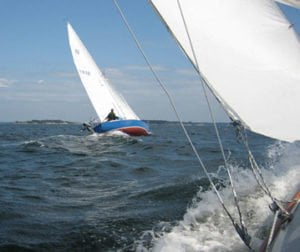 I believe that a leader’s confidence level should actually border on arrogance without crossing the line.
OK, but where’s the line? For that, consider navigating a sailboat. If you point your sailboat directly into the wind, the vessel stalls. It’s a condition called “in-irons”. Conversely a sailboat can reach optimum speed by tacking as close to the wind as possible without reaching the in-irons point. That’s when the hull rises out of the water and approaches the tipping point. Experienced sailboat racers learn to seek that optimum position. Close enough to the wind direction to gain speed while avoiding a stall.
With executive presence, you need a Goldilocks-like combination of confidence and humility.
It’s not what you say, it’s how you say it.
If you could find the Goldilocks position on The Meekness-Arrogance Continuum and know what is just right for you, how would you say it? What would you be saying to yourself to sustain the proper presence?
It’s also about how you look. Polish and poise are always in play.
2 Responses
Tom, thank you for these insights.
My experience is in clearly and specifically defining WHY we are here in the 1st place (Yes, Simon Sinek.) Then backing it up with an attitude of service to the WHY and standing in the back of the credit and praise line and the front of the criticism line.
On you point of how you say things, I’m reminted of Zig Zigler’s addage “If I tell my wife, Honey when I look at you time stands still. There is an entirely different meaning if I say Baby you’ve got a face that would stop a clock.”
Great article, with lots of useful tidbits. Thanks for sharing. As a fellow sailor, I’m reminded that sailing upwind is known as “pointing”, perhaps another useful metaphor. And changing direction away from the wind once you come too close to stalling is known as “falling off”. More to think about.